Autonumbering
GCON4 MFL supports autonumbering configurations. The following section provides a summary of how GCON4 MFL behaves under different autonumbering scenarios.
| Master File | Auto-Numbering | Manual | Status |
|---|---|---|---|
| x | x | Active | |
| Attribute | Autonumbering is applied | ||
| Project | Autonumbering is applied | ||
| Work order | Autonumbering is applied | ||
| Customer | Autonumbering is applied | ||
| Supplier | Autonumbering is applied | ||
| Personnel | Autonumbering is applied |
| Master File | Auto-Numbering | Manual | Status |
|---|---|---|---|
| x | x | Closed | |
| Attribute | Manual is applied | ||
| Project | Manual is applied | ||
| Work order | Manual is applied | ||
| Customer | Manual is applied | ||
| Supplier | Manual is applied | ||
| Personnel | Manual is applied |
| Master File | Auto-Numbering | Manual | Status |
|---|---|---|---|
| x | Active | ||
| Attribute | Autonumbering is applied | ||
| Project | Autonumbering is applied | ||
| Work order | Autonumbering is applied | ||
| Customer | Autonumbering is applied | ||
| Supplier | Autonumbering is applied | ||
| Personnel | Autonumbering is applied |
| Master File | Auto-Numbering | Manual | Status |
|---|---|---|---|
| x | Closed | ||
| Attribute | Manual is applied | ||
| Project | Manual is applied | ||
| Work order | Manual is applied | ||
| Customer | Manual is applied | ||
| Supplier | Manual is applied | ||
| Personnel | Manual is applied |
Assignation of new Id's
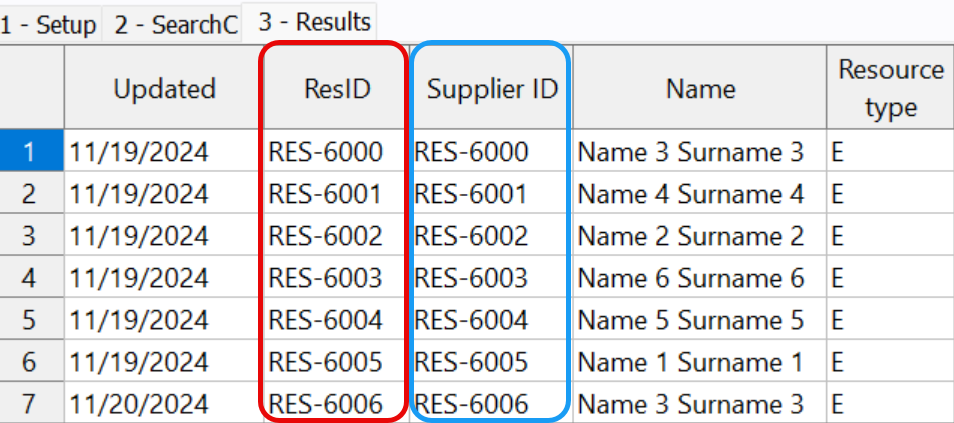
You can review the new IDs assigned by the ERP to the processed records. GCON4 MFL generates and saves a copy of the template used in the Data Export folder, including the updated IDs.
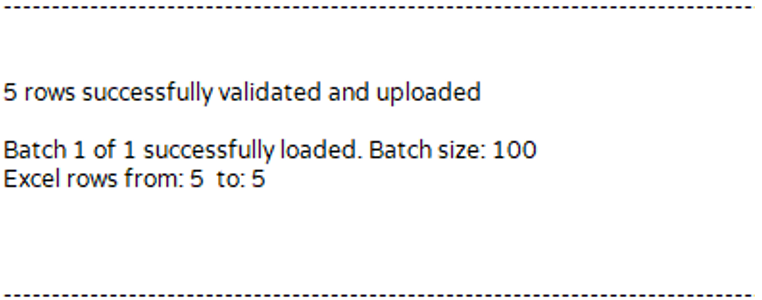
Details of this operation can be found in the MFL04 Server Process log.

Examples of using MFL with Auto-numbering
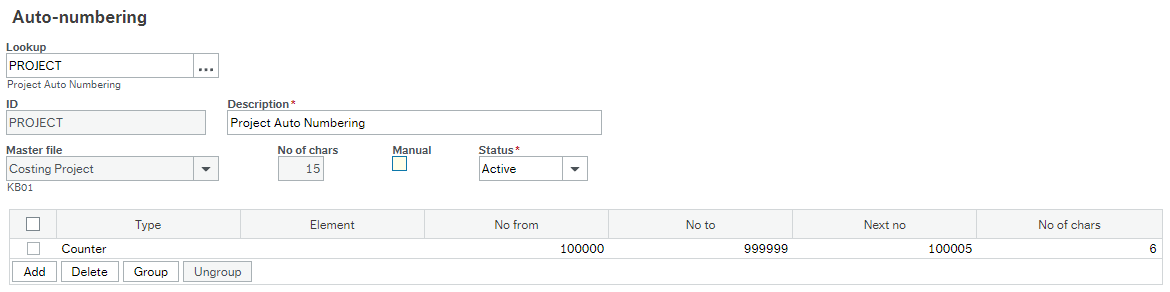
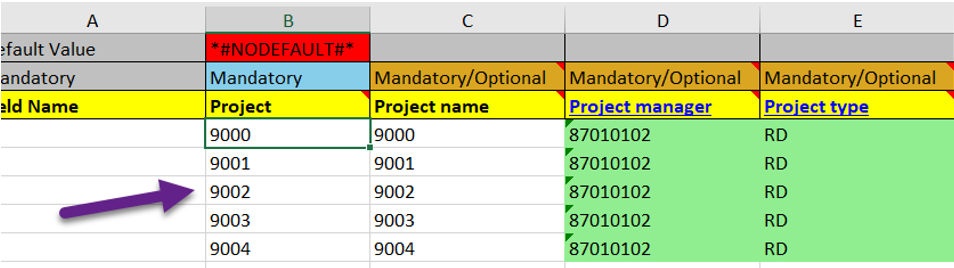
ID for autonumbering
Log detail:
IMPORTANT
There are some important considerations:
GCON4 MFL will always require an ID for manual or even autonumbering ID records. The explanation is that in the templates the records are related in the different tabs (main tab, address, relations, flexi fields, etc) through the ID we indicate in the template.
If the following configuration is set:
Auto-Numbering |
Manual |
Status |
|---|---|---|
x |
x |
Active |
It is not possible to use the same GCON4 MFL insert template for new records if you want some records to have manually assigned IDs and others to use auto-numbering.
In this case, two separate templates are required:
- One for records with manual ID assignment
- One for records using auto-numbering
The system configuration must be adjusted accordingly for each scenario. For example, if you want to use manual ID generation under this configuration, you should temporarily set the auto-numbering status to Closed, load the manual records, and then reactivate auto-numbering to load the automatically generated records.
- When using autonumbering, it is recommended to use IDs in the GCON4 MFL template that fall outside the counter range and do not already exist in the database.
For example, if the autonumbering configuration uses a counter range between 1000–2000, you can use IDs such as 1, 2, 3, etc., in the template.
These IDs should:
Not exist in Unit4 ERP (otherwise, GCON4 MFL will treat them as updates instead of inserts)
Be outside the autonumbering range to avoid potential conflicts
GCON4 MFL does not support more than one active autonumbering configuration. It is necessary to close those that will not be used during the load to avoid errors.
If the HQ_EQUAL_ID parameter is active and MFL encounters an error with the supplier ID (for example, if the apar_id has already been used for another resource), the system will create a new resource and assign a new resource ID to the apar_id.